Rigid plastic bottles are used for thousands of products, from beverages and food items to shampoo, cleaning products, pharmaceuticals, and household liquids. Although a finished bottle may look simple, manufacturing it involves carefully controlled steps that determine its strength, shape, appearance, and compatibility with the product it will contain.
The manufacturing process also plays an important role when businesses need bottles in large quantities or require custom packaging. A reliable Plastic Bottles manufacturer in Pakistan must consider material selection, bottle design, molding conditions, quality control, and production consistency to produce packaging that meets the needs of different industries.
So, how does a plastic resin become a finished bottle? Let’s look at the process step by step.
Rigid plastic bottles are containers made from plastic materials that maintain a defined shape under normal handling and storage conditions. Unlike flexible pouches or films, they have a firm structure and are designed to protect their contents while remaining relatively lightweight.
Rigid bottles can be manufactured in many shapes and sizes. They may have narrow or wide necks, different wall thicknesses, handles, special dispensing openings, or specific closure systems depending on their intended application.
Some common characteristics include:
Several plastic materials can be used to manufacture rigid bottles, with PET, HDPE, and PP among the commonly used options.
The appropriate material depends on factors such as the product being packaged, chemical compatibility, required strength, appearance, temperature conditions, and intended storage environment.
PET is widely used for beverage and food packaging. It offers good strength while providing a clear appearance that allows consumers to see the product inside.
PET is particularly common for beverage packaging, including plastic juice bottles. Its combination of clarity, relatively low weight, and useful mechanical properties makes it suitable for many consumer products.
The material can also be formed into jars and other packaging formats when the design and application call for it.
HDPE is known for its durability and resistance to many chemicals. It is used for a variety of packaging applications, including personal care products, household products, food products, and industrial liquids.
HDPE bottles are available in different shapes and thicknesses. Depending on the application, they can be designed to provide a firm structure while remaining practical for transportation and everyday use.
PP is another plastic material used for containers and packaging where rigidity and higher temperature resistance may be required.
Its properties can make it suitable for particular containers, closures, and packaging applications. As with PET and HDPE, the choice of PP depends on the product requirements, bottle design, processing method, and expected conditions of use.
A manufacturer does not simply select a material based on appearance. The product, bottle dimensions, manufacturing method, required performance, and storage conditions all need to be considered.
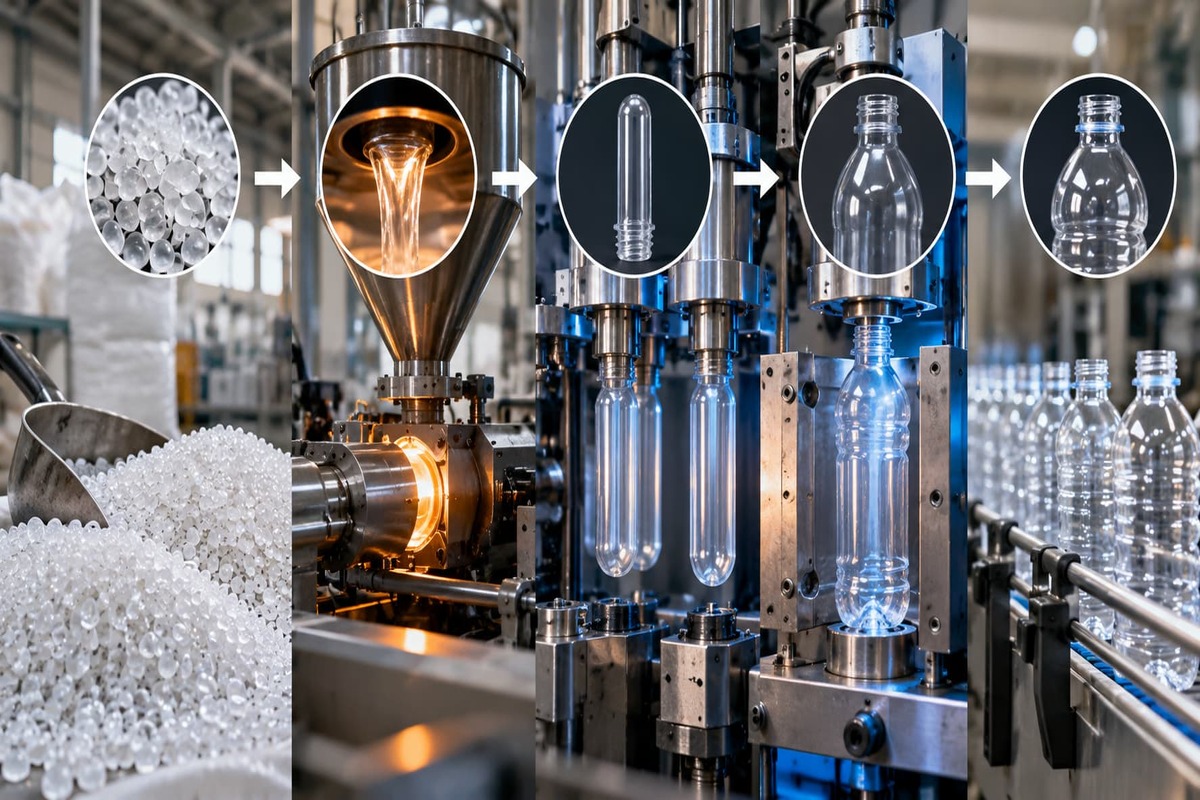
The process begins with selecting the appropriate plastic resin. The material is chosen according to the bottle's intended application and required properties.
Plastic resin generally arrives in small pellets or granules. Before production, the material may be inspected and prepared according to the requirements of the manufacturing process.
Material quality matters because variations in the raw material can affect the finished bottle's appearance, strength, weight, and consistency.
For certain materials, proper drying or other preparation may also be required before processing.
The prepared plastic resin is fed into manufacturing equipment where controlled heat softens or melts the material.
Temperature control is important during this stage. If the processing conditions are not properly controlled, the material may not form consistently, which can affect the finished product.
Manufacturers use controlled processing conditions to produce a stable flow of material that can be formed into the required bottle components.
The next stage depends on the material and manufacturing method being used.
PET bottles commonly begin with a preform. A preform is a small, thick plastic component that already contains the bottle's neck and closure area. It is later heated and expanded into the final bottle shape.
Other bottles, particularly those produced using extrusion blow molding, may begin with a parison. A parison is a tube-like piece of softened plastic that is placed into a mold and expanded.
The preform or parison provides the starting structure for the bottle.
Blow molding is one of the key processes used to create many rigid plastic bottles.
The heated preform or parison is positioned inside a mold. Air pressure is then introduced, causing the softened plastic to expand outward until it contacts the inside walls of the mold.
Once the plastic reaches the mold walls, it takes on the shape defined by the mold.
The mold therefore plays a major role in determining the bottle's dimensions, body shape, neck design, curves, and other visual characteristics.
Different molding processes may be used depending on the material, bottle design, production requirements, and equipment.
After the bottle has been formed, it needs to cool so the plastic can become sufficiently rigid.
Controlled cooling helps the bottle maintain its intended shape and dimensions. If cooling conditions are inconsistent, the finished container may experience dimensional variations or other quality problems.
Once the bottle has cooled sufficiently, it can be removed from the mold and moved to the next stage.
Depending on the manufacturing process, excess plastic may remain around certain areas of the bottle. This material may need to be trimmed or removed.
The bottle is then checked for clean edges, proper neck formation, and overall finish.
The neck area is especially important because it needs to work correctly with the intended cap or closure. A properly manufactured bottle should also provide an appropriate surface for labeling, printing, or other finishing requirements.
Quality control should take place throughout manufacturing rather than only after production has finished.
Common checks can include:
The exact tests depend on the bottle's intended use. A beverage container may have different requirements from a household chemical bottle or a pharmaceutical container.
For businesses purchasing bottles in bulk, consistency is particularly important. Bottles should remain within the agreed specifications from one production batch to another.
Bottle design directly affects manufacturing requirements.
A bottle with a complex shape, unusual neck, thin walls, or specific dispensing system may require different tooling and processing conditions from a simple container.
Design can influence:
For example, a bottle designed for efficient transportation may need dimensions that allow multiple units to be packed closely together. A bottle intended for easy pouring may require a particular neck and opening.
This is why businesses developing custom packaging should consider manufacturing requirements during the design stage rather than after the design has been finalized.
Custom bottles are usually developed around the requirements of a particular product or packaging application.
The process commonly includes several stages:
Customization can involve bottle shape, capacity, color, neck finish, closure type, surface design, and other specifications.
The more specialized the design, the more important it becomes to discuss manufacturing feasibility before committing to production.
Businesses purchasing packaging in large quantities need to evaluate more than the unit price.
When considering Plastic Bottle wholesale, buyers should review:
Businesses with recurring packaging needs may also benefit from working directly with a manufacturer. Direct communication can make it easier to discuss specifications, production quantities, custom designs, and future orders.
For large-volume purchasing, consistency is particularly important. A bottle that meets the specification during one production run should continue to meet the same requirements in subsequent batches.
Rigid plastic bottles are used across a wide range of industries.
Food and beverage packaging is one of the most familiar applications. Rigid bottles can be used for juices, sauces, food ingredients, and other packaged products.
Plastic juice bottles, for example, can be designed around the required capacity, closure, product characteristics, and handling conditions.
Shampoo, body care products, liquid soaps, and other personal care products commonly require bottles that are easy to handle and compatible with suitable dispensing closures.
Cleaning products, liquid detergents, and other household formulations can be packaged in rigid plastic bottles designed for their specific contents.
Plastic packaging can also be used for pharmaceutical and healthcare products when the selected material, manufacturing process, and container specifications meet the applicable requirements.
Rigid bottles are also used for industrial liquids, specialty products, agricultural products, and many other consumer or commercial applications.
The appropriate packaging format depends on the product and the conditions in which it will be stored, transported, and used.
Although bottles and jars can both be made from similar plastic materials, their designs serve different purposes.
Bottles generally have narrower openings and are useful for products that need to be poured, squeezed, or dispensed. Their shape can also make them easier to hold during use.
Plastic jar containers, on the other hand, usually have wider openings. This makes them useful for products that need to be scooped out, removed by hand, or accessed with a larger utensil.
For example, a product requiring controlled pouring may be better suited to a bottle, while a product that needs a wide opening may be more practical in a jar.
The choice should be based on product characteristics, consumer use, filling requirements, storage, transportation, and closure needs.
Businesses evaluating a Plastic Bottles manufacturer in Pakistan should look beyond the product catalog and consider the manufacturer's actual production capabilities.
Useful factors to evaluate include:
It is also useful to discuss technical specifications before placing a large order. Bottle dimensions, material type, weight, neck finish, closure, color, and intended application should be clearly defined.
For custom packaging, businesses should also understand the tooling requirements and development process before production begins.
A reliable supplier should be able to communicate clearly about what can be produced, what specifications are required, and how quality will be maintained during production.
Rigid plastic bottle manufacturing involves much more than simply shaping plastic.
The process starts with selecting the appropriate resin and preparing it for production. The material is then heated, formed into a preform or parison, expanded through a molding process, cooled, finished, and inspected.
Every stage can influence the final product. Material selection affects performance. Mold design determines the bottle's shape. Processing conditions influence consistency. Quality checks help ensure that the finished bottles meet the required specifications.
For businesses purchasing packaging, understanding this process can make it easier to select the right bottle for a particular product.
Whether you need Plastic Bottle wholesale quantities, Plastic juice bottles, or plastic jar containers, the right packaging should be selected according to the product, required performance, design, quantity, and supply requirements.
When evaluating a manufacturer, consider the complete picture: material capabilities, manufacturing processes, quality control, customization options, production capacity, and consistency. These factors help businesses choose packaging that works reliably from production through storage, transportation, and final use.

This post has been authored and published by one of our premium contributors, who are experts in their fields. They bring high-quality, well-researched content that adds significant value to our platform.









Dutables provides reliable educational resources, study materials, academic guides, and learning content to help students and educators succeed.